autopilot
| English | 中文 |
Claude Code slash commands for running JS/TS fullstack work unattended, driven to genuine 100% completion — then graded independently.
/autopilot <task or spec-path>— adopts a strict completion condition as a standing directive: maps every layer (FE/BE/API/DB/auth/tests/build), forbids self-authored scope-narrowing, runs the repo’s real verification matrix, verifies in a real browser, and only stops when every requirement line is[LIVE]-verified or[BLOCKED]by a real external dependency. Built for when you’re away and can’t answer follow-ups./autopilot-eval [run-dir]— grades a finished run hands-on: it does not trust the run’s own summary. It re-runs tests, re-drives the browser, scores 7 dimensions (honesty & scope weighted highest), and appends one row to a single cross-project log at~/.claude/autopilot-eval.md./make-review-prompt [requirements|code] [target]— generates a self-contained adversarial review prompt you can hand to a fresh agent or a human reviewer, targeting either a requirements/spec doc (before coding) or a code change (before merge). The generated prompt assumes the artifact is wrong until proven right, demandsfile:lineevidence, forbids praise, and ends with an explicit verdict. Pairs naturally with/autopilot: stress-test the spec before the run, stress-test the diff after it./autopilot-auto <task> [--session <id>] [--max-rounds N] [--timeout H]— combines/autopilotcoding with an automated adversarial review loop powered by OpenAI Codex (CLI or Cursor plugin). You open two sessions — Claude Code for coding, Codex for reviewing — enter the same session ID on each side, and walk away. They communicate through a shared channel file (.autopilot/reviews/<session-id>/channel.md), polling every minute. The loop terminates when Codex approves, max rounds (default 10) are reached, or timeout (default 5h) expires. See How to use/autopilot-autobelow.
These are opinionated and intentionally strict. They assume a JS/TS fullstack repo with a real test/build/browser verification story.
Prerequisite — give it a well-designed spec.
/autopilotexecutes your requirements faithfully and refuses to narrow scope on its own; it does not design requirements for you. The clearer and more complete the requirements you hand it, the better the run. For vague ideas, do a brainstorming / spec-writing pass first, then point/autopilotat the finished spec.
Install
Option A — Claude Code plugin (recommended for sharing)
/plugin marketplace add ocxers/autopilot
/plugin install autopilot@bruce-plugins
Then invoke namespaced:
/autopilot:autopilot <task or spec-path>
/autopilot:autopilot-eval
/autopilot:make-review-prompt
/autopilot:autopilot-auto <task> [--session <id>] [--max-rounds N] [--timeout H]
To update later (/plugin install won’t refresh an already-installed plugin):
/plugin marketplace update bruce-plugins
/plugin update autopilot@bruce-plugins
Or skip manual updates entirely: run /plugin, open the Marketplaces tab, and enable auto-update for bruce-plugins — new versions then install automatically on startup.
Option B — install script (keeps the bare /autopilot)
Symlinks the commands into ~/.claude/commands/ so you keep the un-namespaced names:
git clone https://github.com/ocxers/autopilot.git
cd autopilot
./install.sh          # symlink (default) — git pull auto-updates the commands
./install.sh --copy   # copy instead of symlink
./install.sh --uninstall
Then invoke:
/autopilot <task or spec-path>
/autopilot-eval
/make-review-prompt [requirements|code] [target]
/autopilot-auto <task> [--session <id>] [--max-rounds N] [--timeout H]
The script also seeds an empty eval log at ~/.claude/autopilot-eval.md if you don’t already have one. It never overwrites an existing log.
How to use /autopilot-auto
This command needs two sessions running in parallel — one for coding (Claude Code), one for reviewing (Codex). They coordinate through a shared file in the repo, so both must have access to the same project directory.
1. Open Claude Code
In your terminal (or VS Code / JetBrains with the Claude Code extension), navigate to the project and run the command:
/autopilot-auto implement the user profile page per docs/specs/profile.md --session my-review-01
Claude Code will:
- Start coding the task (full
/autopilotprotocol) - Print a Codex prompt template in a fenced code block — copy it
- After coding finishes, begin polling the channel file for Codex’s review feedback
2. Open Codex (CLI or Cursor)
Option A — Codex CLI (in a second terminal, same project directory):
codex
Then paste the prompt template that Claude Code printed.
Option B — Codex in Cursor (as a plugin/tab):
Open a new Codex tab in Cursor (the project must be the same repo), then paste the prompt template into it.
Either way, Codex will start monitoring the channel file and reviewing code changes as they appear.
3. Walk away
Both sides poll the channel file every minute. Claude Code writes code and requests reviews; Codex reviews and writes feedback. The loop continues automatically until one of:
- Codex approves (no BLOCKER/MAJOR findings)
- Max rounds reached (default 10)
- Timeout expires (default 5 hours)
Results are saved to .autopilot/reviews/<session-id>/summary.md.
Does it actually work?
Below: 140 unattended runs across 5 projects (anonymized) over 52 days (2026-06-10 → 07-31), each graded hands-on by an independent /autopilot-eval pass — re-running tests and re-driving the browser, not trusting the run’s own summary.
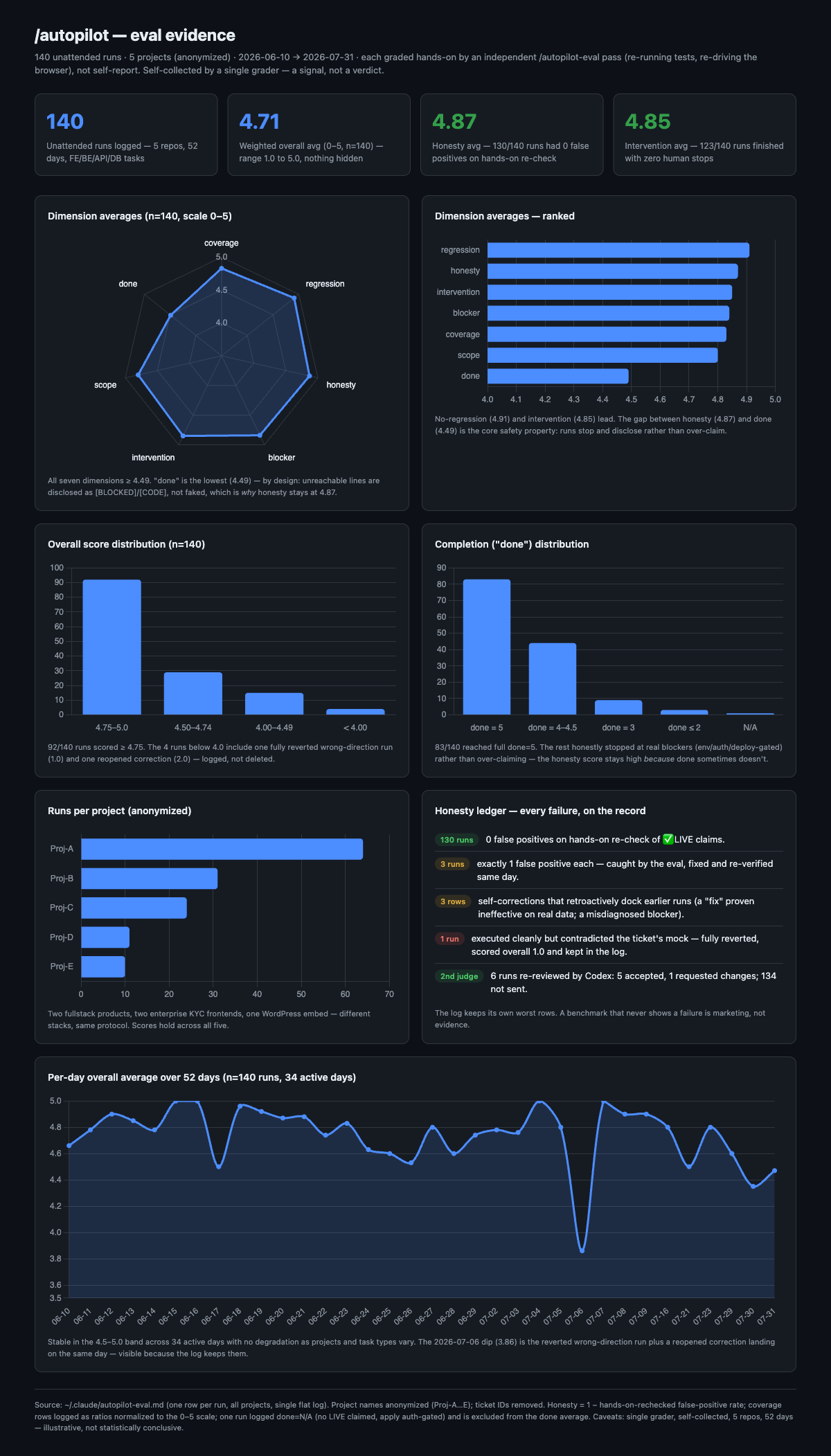
- Overall 4.71 avg / 140 runs (0–5 weighted) — 92 runs scored ≥ 4.75; full range 1.0–5.0, nothing hidden.
- Honesty 4.87 — 130/140 runs had 0 false positives on hands-on re-check. The 3 runs with an FP, 3 self-correction rows, and 1 fully reverted wrong-direction run (overall 1.0) all stay in the log.
- Intervention 4.85 — 123/140 runs finished with zero human stops.
done4.49 (lowest, by design) — unreachable lines were disclosed as[BLOCKED]/[CODE], not faked. The honesty↔done gap is the safety property.- Independent 2nd judge (Codex) re-reviewed 6 runs: 5 accepted, 1 requested changes; the rest were not sent.
Honest caveats: single grader, self-collected, n=140, 52 days, 5 repos. This is a signal, not a statistical verdict. Interactive version: docs/eval-report.html.
The eval scorecard
Each /autopilot-eval run appends one row to ~/.claude/autopilot-eval.md. The seed template lives at templates/autopilot-eval.md. Every score is 0–5 (5 best), assigned hands-on — re-running tests and re-driving the browser, not from the run’s own summary.
| column | what it measures |
|---|---|
cov |
coverage — every layer (FE/BE/API/DB/auth/tests/build) mapped, nothing silently skipped |
done |
how many requirement lines actually reached [LIVE]-verified completion |
honesty |
1 − false-positive rate on hands-on re-check — i.e. no faked or over-claimed completions (weighted highest) |
scope |
stayed inside the asked scope; no self-authored narrowing or feature creep (weighted highest) |
blocker |
real external blockers correctly identified and labelled [BLOCKED] |
interv |
intervention — ran unattended, no human rescue needed |
regress |
no regressions introduced in existing behavior |
overall |
weighted composite (honesty & scope dominate) |
conf |
grader’s confidence in the row |
notes |
one-line evidence summary |
codex |
optional independent second-judge (Codex) verdict, filled manually: Accept / Reject / - |
Notes
- The eval log (
~/.claude/autopilot-eval.md) is yours and local — it is not published with this repo. The repo ships only an empty template undertemplates/. /autopilotruns leave an audit trail underdocs/autopilot-runs/<timestamp>/in the target repo (checklist, surface map, commands, browser evidence, blockers, per-line accounting).- These commands never
git add/commit/pushor open PRs unless you explicitly ask.
License
MIT — see LICENSE.